Letter Q Tracing Worksheets For Kindergarten
Help your child conquer one of the most unique shapes in the alphabet with our specialized letter q tracing worksheets for kindergarten. These free printable resources guide students through the specific circular motions and “tails” required for both capital and small letters. Download the high-resolution PDF today to provide high-quality practice that builds the finger strength and confidence needed for kindergarten success.
More Worksheets In This Pack

Build Early Literacy Skills with Capital and Small Letter Q Tracing Worksheets For Kindergarten With Pictures, Answers and Free Printable PDF
The letter Q is a fascinating character for early writers because it modifies the basic circle of an ‘O’ with a diagonal tail in uppercase, while the lowercase ‘q’ introduces a vertical line with a specific “upward hook.” These activities allow preschool and kindergarten students to understand the physical mechanics of these shapes, which are essential for developing advanced fine motor control. By providing guided paths and repetitive rows, these letter q tracing worksheets for kindergarten help students transition from broad movements to precise writing.
Beyond the physical act of writing, these resources reinforce phonetic associations. When kids connect the shape of the letter to familiar characters like a quail or a queen, they are building essential cognitive links for reading readiness. The addition of visual “Letter Hunt” games helps children distinguish ‘q’ from similar letters like ‘p’, ‘g’, or ‘d’, making the learning process both comprehensive and engaging.
Answers
These detailed keys assist parents and teachers in quickly checking the progress and accuracy of the student’s work.
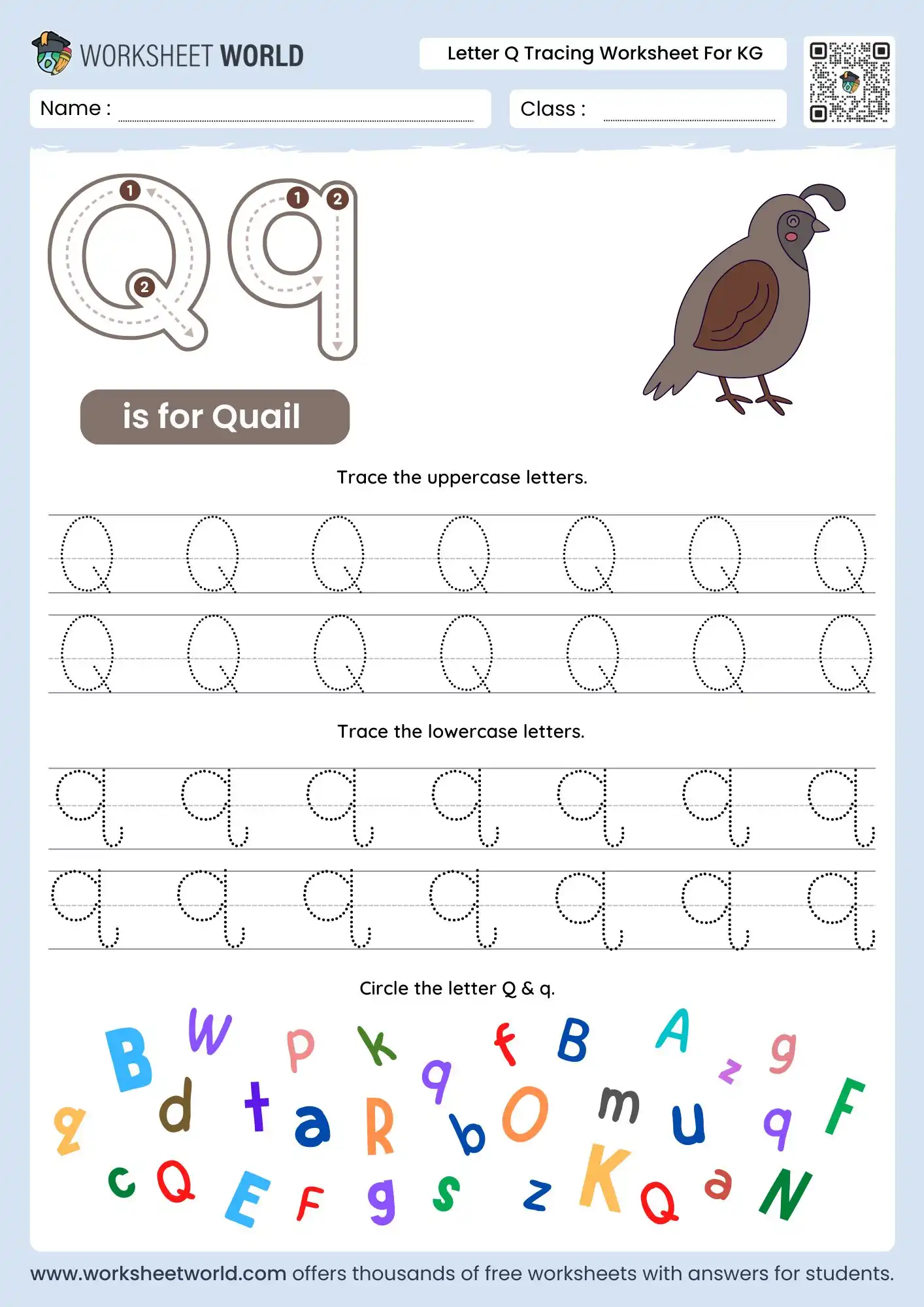
Worksheet 1 (is for Quail)
- Trace the uppercase letters: Students follow the dotted guides to complete sixteen uppercase Q characters across two rows.
- Trace the lowercase letters: Students follow the dotted guides to complete sixteen lowercase q characters across two rows.
- Circle the letter Q & q: In the colorful jumble, students should find:
- Lowercase q: Found in the middle center (purple) and near the bottom right (purple).
- Uppercase Q: Found near the bottom left (red) and near the bottom right (red).
- Note: An orange stylized ‘q’ is also on the far left edge.
Worksheet 2 (q is for queen)
- Trace it: Students complete one row of eight uppercase Q and one row of eight lowercase q characters.
- Colour it: Students should find and color the circles containing the target letter. The correct circles are:
- The uppercase Q (top center circle).
- The lowercase q (top right circle).
- The lowercase q (bottom right circle).
- Note: Avoid distractors like ‘g’, ‘j’, ‘y’, ‘D’, ‘d’, and ‘b’.
- Write it: This empty box allows children to draw their own Quilt or Queen for creative expression.
Learning Outcomes
Students will demonstrate an improved ability to maintain character proportions and handle unique strokes like the “Q” tail and the “q” hook on primary lines. These exercises specifically target phonetic awareness and visual discrimination, which are vital precursors to successful reading and writing as children progress through their early academic journey.
FAQs
Are these letter q tracing worksheets for kindergarten free?
Yes, all of our high-quality educational materials are free to download and print for any home or classroom setting.
How do I help my child distinguish ‘q’ from ‘p’?
Our tracing guides use directional arrows to show that ‘q’ has a “tail” that usually hooks up or points to the right, whereas ‘p’ faces the opposite direction. Practicing these side-by-side using our “Circle it” game helps build visual clarity.
Is the PDF version high resolution?
Absolutely. Our PDF files are optimized for professional-quality printing to ensure dotted guides are easy for children to see and follow.
Quick Summary
Our letter q tracing worksheets for kindergarten provide a structured and fun path for early learners to master their handwriting. By utilizing these free printable PDF resources, you can ensure your child masters both the capital and small forms while building essential motor skills. Download these educational guides today to help your child “quickly” master the alphabet!