Letter W Worksheets For Preschoolers and Kindergarten
Set your child’s literacy journey in motion with our specialized letter w worksheets. Designed for preschool and early elementary students, these free printable resources focus on mastering both capital and small alphabet formation. Download our high-resolution PDF today to provide high-quality practice that combines technical handwriting discipline with fun, interactive activities.
More Worksheets In This Pack


Interactive Alphabet Practice With Letter W Worksheets With Pictures, Answers and Free PDF For Preschool and Kindergarten
The letter W is a vital milestone for young writers as it introduces the concept of sharp, repeating diagonal lines. These activities allow students to understand the physical mechanics of slanted strokes, which are foundational for developing precision and fine motor control. By providing guided paths and repetitive rows, these educational sheets help learners transition from broad movements to precise, legible writing on primary lines.
Beyond the physical act of writing, these resources reinforce phonetic associations through visual discovery. In our interactive cut-and-paste and search sections, children identify objects like a watermelon, whale, and windmill. This multisensory approach-combining writing, scanning, and tactile play-ensures that foundational literacy concepts are internalized effectively, making the entire learning journey rewarding and memorable.
Answers
These detailed keys assist parents and teachers in quickly checking the progress and accuracy of the student’s work.
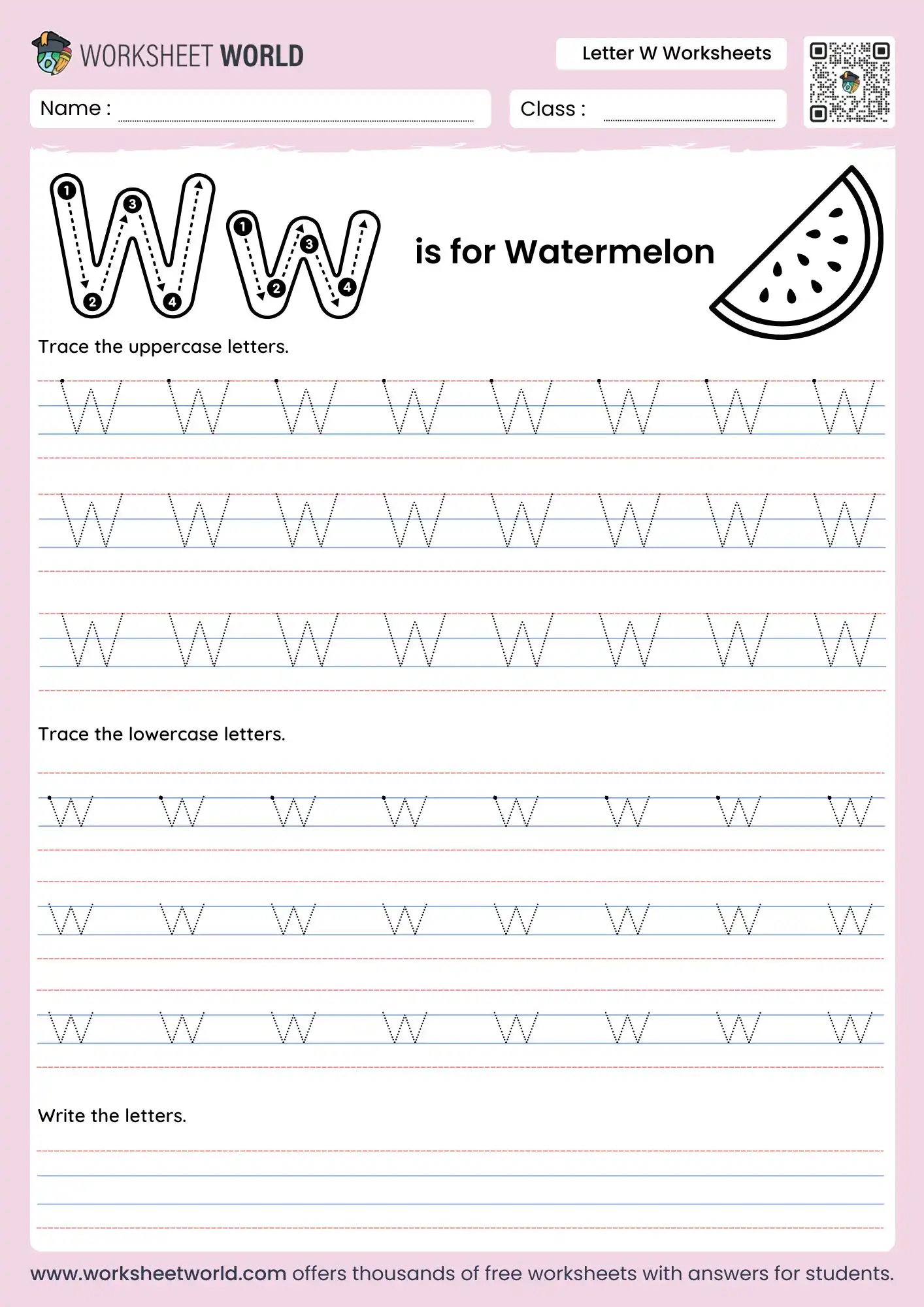
Worksheet 1 (is for Watermelon)
- Primary Example: A crisp slice of Watermelon.
- Stroke Guide: Both uppercase W and small w are formed using four slanted strokes.
- Tracing Practice: Three rows for capital W and three rows for small w.
- Independent Writing: Two empty primary lines are provided at the bottom for free-hand practice.
Worksheet 2 (Trace the Letter Activity – Watermelon)
- Trace section: Students follow the large models and then complete one row each of uppercase and lowercase tracing.
- Circle grid: Students should circle the following:
- Uppercase W: Row 3 (1st position).
- Lowercase w: Row 1 (2nd), Row 3 (3rd).
- The distractors to ignore are: r, y, t, j, O, M.
Worksheet 3 (Color, Cut, and Glue)
- Students should color, cut, and glue the following objects into the circles on the large “W”:
- Whale
- Window
- Worm
- Watch
- Watermelon
- Windmill
- Wizard
- Wheel
- The distractor items to exclude are: Bowl (B) and Wolf (W—actually, Wolf starts with W! Include the Wolf). The bowl is the only distractor here.
Learning Outcomes
Students will demonstrate an improved ability to maintain character proportions and handle sharp, diagonal strokes on primary lines. These exercises specifically target phonetic awareness and visual discrimination, which are vital precursors to successful reading and writing as children progress through their early academic journey.
FAQs
Are these letter w worksheets free to download?
Yes, all high-quality educational materials provided here are free to support the growth of young learners at home or in the classroom.
How do I teach the difference between the capital W and small w?
Emphasize that while the shape is identical, the capital W is tall and touches the top line, while the small w is half the height and stays within the middle and bottom lines.
Do these sheets cover both capital and small letters?
Absolutely. Each worksheet is designed to provide balanced practice for both capital and small forms of the letter.
Quick Summary
Our collection provides a structured and fun path for early learners to master their alphabet formation. By utilizing these free printable PDF resources, you can ensure your child masters both the capital and small forms while building essential motor skills. Download these educational guides today to help your child “wonder” and learn with every stroke!