
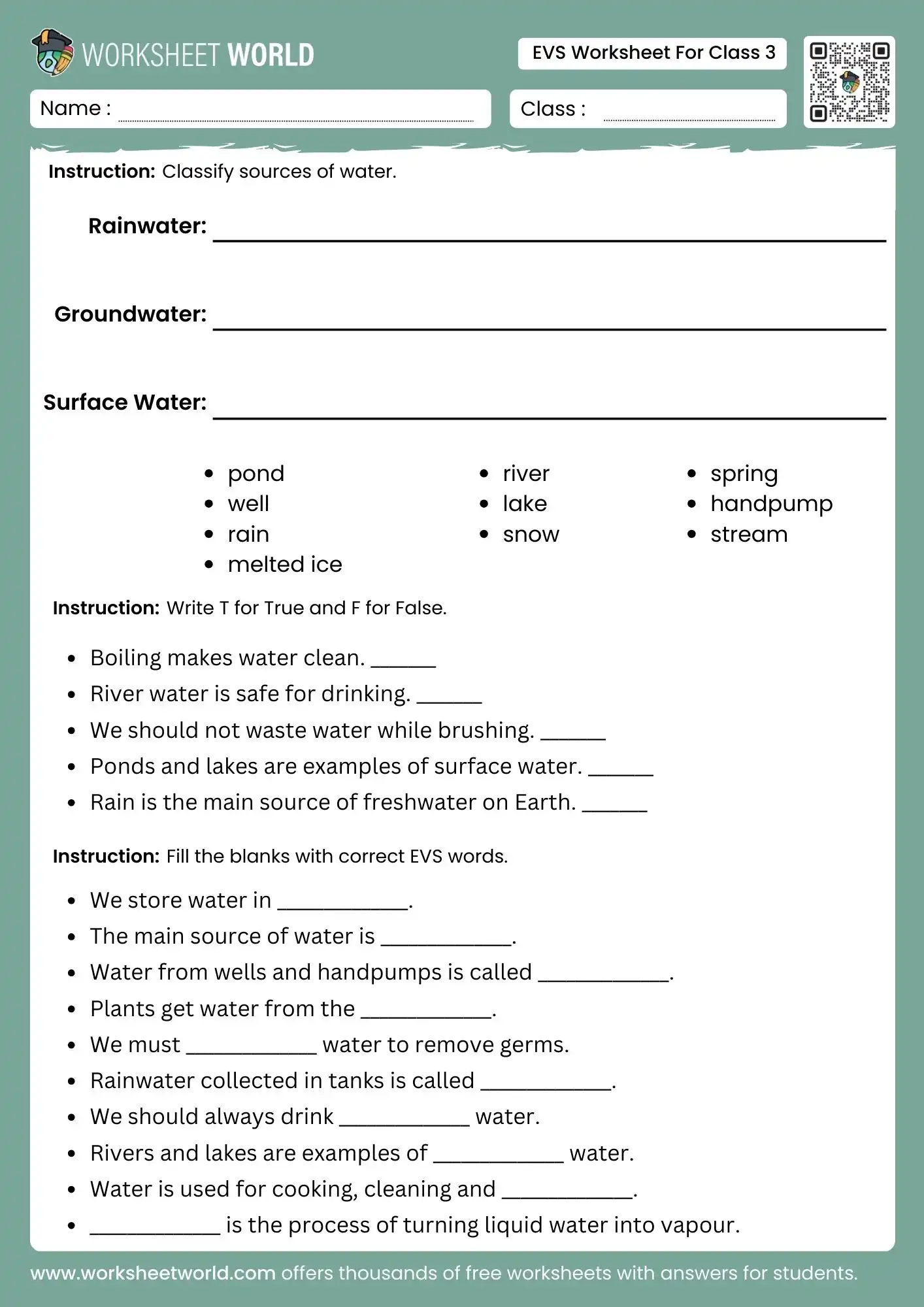
EVS Worksheet For Class 3 (Water Sources and Uses PDF)
Learning about water, its sources, and its importance is a key part of environmental studies, and that is why the evs worksheet for class 3 helps children build strong foundational knowledge. Through classification, true-or-false questions, and fill-in-the-blanks, students understand concepts clearly and practise them in an interactive way.
EVS Worksheet For Class 3 With Answers and Free PDF
Worksheets with mixed exercises allow children to explore ideas from different angles. When students classify sources, they begin to understand how water reaches us. True-or-false questions strengthen quick thinking, while fill-ups improve vocabulary and clarity of concepts.
This worksheet also helps children remember essential facts such as freshwater sources, safe water practices, and how we use water daily. By combining short activities in one page, it supports both classroom teaching and revision.
Answers
Here are the solved answers for all sections of the worksheet.
Classify sources of water:
- Rainwater: rain, melted ice, snow
- Groundwater: well, handpump, spring
- Surface Water: pond, river, lake, stream
True or False:
- Boiling makes water clean. T
- River water is safe for drinking. F
- We should not waste water while brushing. T
- Ponds and lakes are examples of surface water. T
- Rain is the main source of freshwater on Earth. T
Fill in the blanks:
- We store water in containers.
- The main source of water is rain.
- Water from wells and handpumps is called groundwater.
- Plants get water from the soil.
- We must boil water to remove germs.
- Rainwater collected in tanks is called rainwater harvesting.
- We should always drink clean water.
- Rivers and lakes are examples of surface water.
- Water is used for cooking, cleaning and drinking.
- Evaporation is the process of turning liquid water into vapour.
Learning Outcomes
By completing this worksheet, students understand different water sources, learn safe water practices, and build vocabulary through application-based questions. It improves reasoning, environmental awareness, and concept clarity.
FAQs
These common questions relate to water concepts and may help children better understand the topic while practising this worksheet.
How does an evs worksheet for class 3 help children learn about water?
It strengthens understanding through classification, statements, and practical fill-ups.
Why is learning about water sources important?
It helps children know where water comes from and how to use it responsibly.
What is the easiest way to teach children about water safety?
Encourage discussion about boiling, filtering, and avoiding waste during daily routines.
Quick Summary
The evs worksheet for class 3 helps children understand water sources, safe water habits, and everyday uses of water. With classification, true-or-false exercises, and fill-in-the-blanks, learners build confidence while practising key concepts. This worksheet supports both revision and real-life application, making environmental studies easier to understand.
Was this worksheet helpful?
Download Our Official App
Get exclusive access to premium worksheet PDFs for free! Download the A To Z Worksheet App to explore 2,000+ interactive resources in 10+ languages. Perfect for offline learning and quick printing.

Explore Our Premium Worksheet Store!
Discover our premium collection of worksheets for kids of all ages! Available in English, Hindi, Gujarati, and Marathi bundles, these resources are perfect for home learning and classroom activities. Enhance your child’s learning experience with our carefully designed worksheets.
Explore Now*Terms & conditions apply. Worksheets are intended for educational purposes only.