
Telling Time Worksheets (Free Analogue Clock Practice PDF for Students)
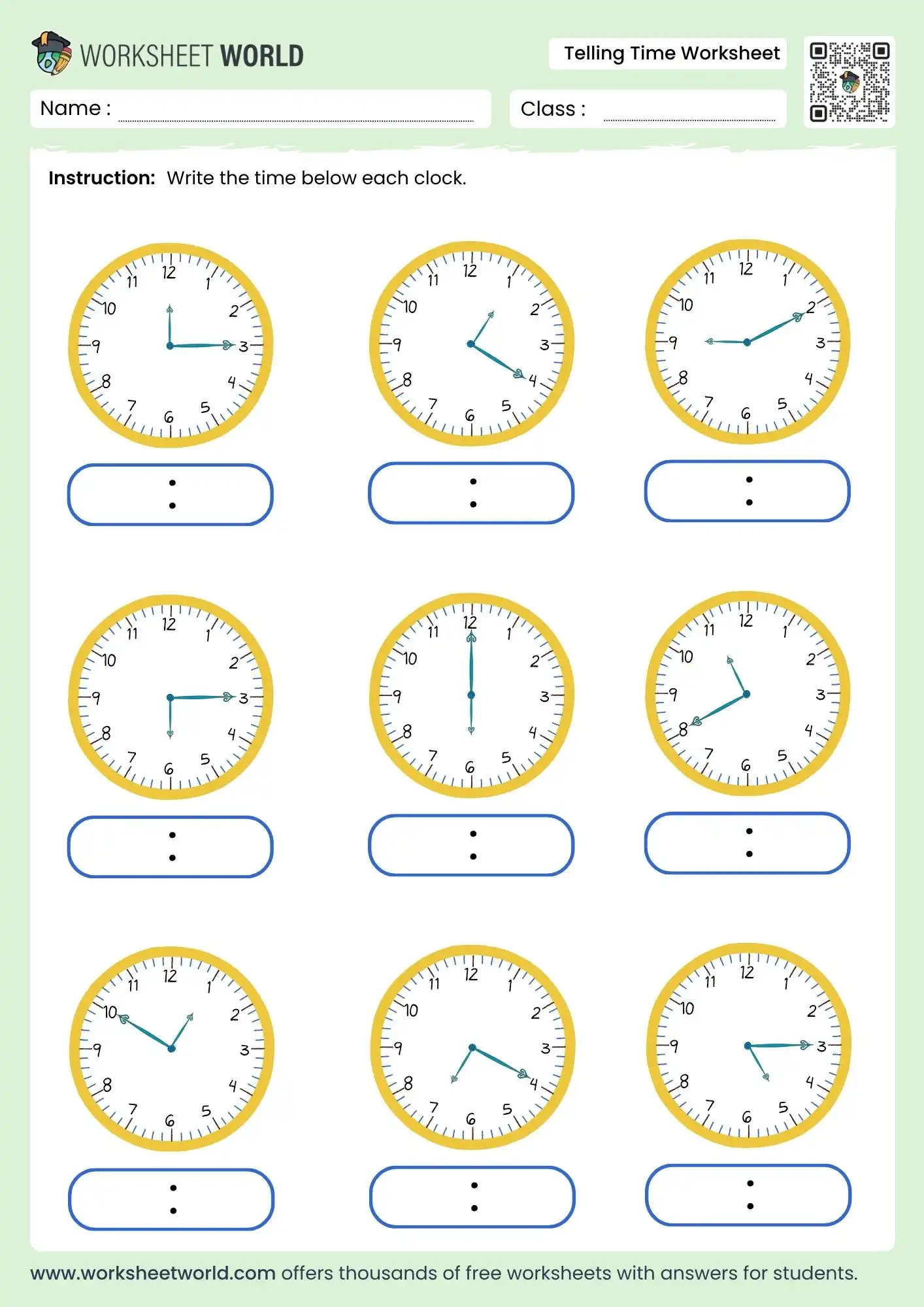
These Telling Time Worksheets help children practise analogue clock reading with simple activities that match the learning tasks shared in the bellow section. Students carefully observe each clock and write the correct hour and minute in the box provided.
Telling Time Worksheets With Answers and Free PDF For Grade 1, Grade 2, Grade 3 and Grade 4
Learning to read analogue clocks is an important foundational math skill for young students. These worksheets gradually guide children from recognising hour positions to interpreting minute-hand movements. The clocks are clearly illustrated, helping learners focus on both hands without unnecessary distractions.
The worksheet offers a variety of time examples, allowing students to strengthen their understanding through consistent practice. With multiple levels suitable for Grades 1 to 4, this activity builds confidence, improves accuracy, and supports the development of essential everyday time-reading skills.
Answers
Below are the correct times for each analogue clock shown in the worksheet. These answers help learners check their work and understand how the hour and minute hands move together.
- 1. 8:10
- 2. 1:20
- 3. 2:35
- 4. 5:15
- 5. 12:00
- 6. 10:55
- 7. 9:50
- 8. 6:40
- 9. 3:15
Learning Outcomes
This worksheet helps children develop accuracy in reading analogue clocks, identify hour–minute relationships, and understand how time progresses. It strengthens observation skills, builds confidence, and supports early math development across multiple grade levels.
FAQs
These general questions help clarify common doubts students and parents may have while practising analogue time.
How do Telling Time Worksheets help children learn quicker?
They provide repeated exposure to different clock positions, helping students recognise time patterns easily.
Why does the minute hand move faster around the clock?
Because it completes one full rotation every 60 minutes, showing minute changes clearly.
When should children start learning half-past and quarter-past?
After mastering o’clock times and basic minute positions.
How can parents support time learning at home?
By asking children to read clocks during daily routines like meals and bedtime.
Quick Summary
These Telling Time Worksheets provide clear, structured practice for students learning to read analogue clocks. The exercises cover different time formats, helping children understand hour and minute placement correctly. With the included answer key, students can review their work independently and build confidence in reading time.
Was this worksheet helpful?
Download Our Official App
Get exclusive access to premium worksheet PDFs for free! Download the A To Z Worksheet App to explore 2,000+ interactive resources in 10+ languages. Perfect for offline learning and quick printing.

Explore Our Premium Worksheet Store!
Discover our premium collection of worksheets for kids of all ages! Available in English, Hindi, Gujarati, and Marathi bundles, these resources are perfect for home learning and classroom activities. Enhance your child’s learning experience with our carefully designed worksheets.
Explore Now*Terms & conditions apply. Worksheets are intended for educational purposes only.