
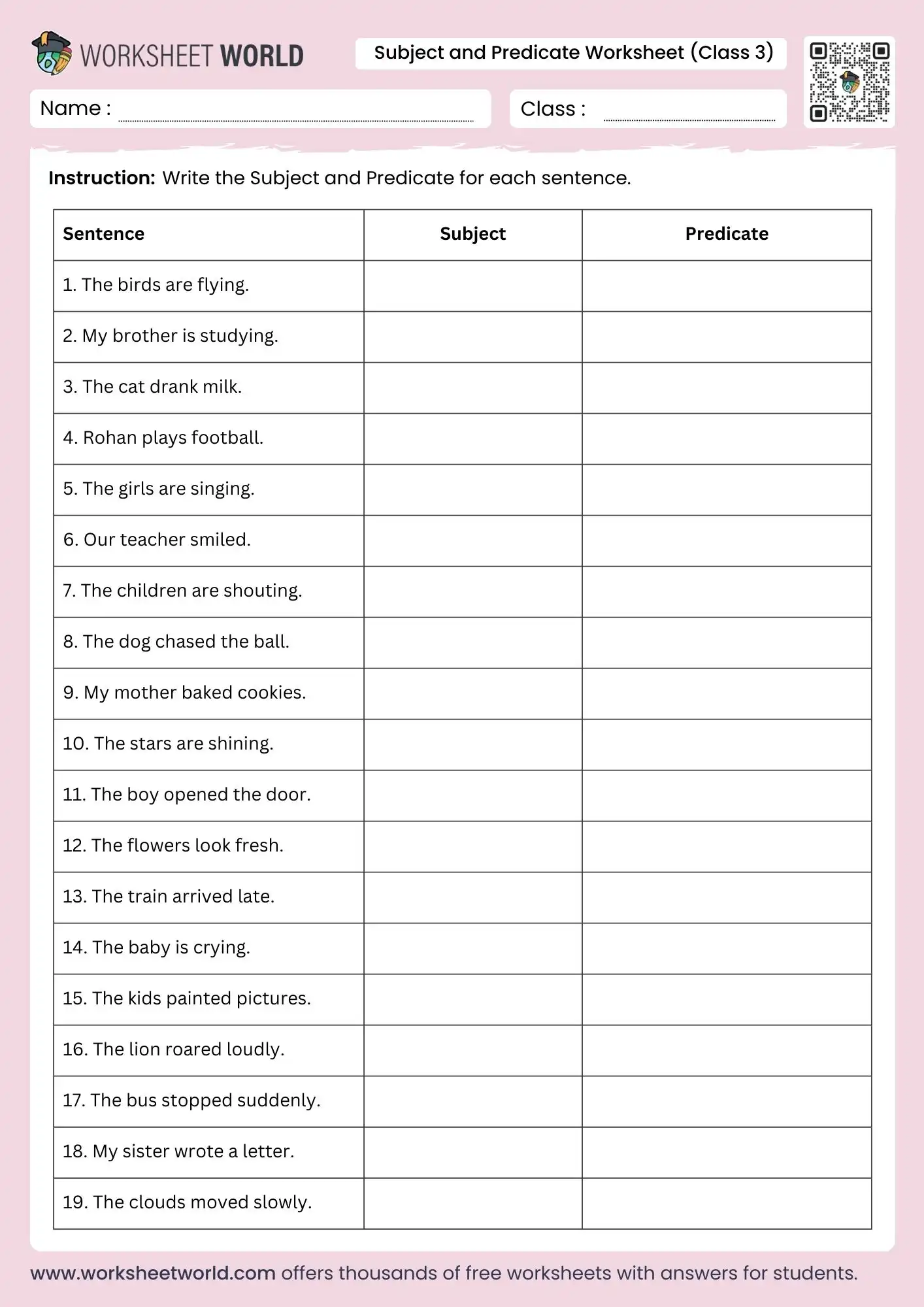
Subject and Predicate Worksheet For Class 3
This subject and predicate worksheet for class 3 helps children understand how every sentence has two important parts. With clear examples and simple activities, students can easily identify who or what the sentence is about and what action or information follows. This extra grammar worksheet supports classroom learning and strengthens sentence structure practice.
Subject and Predicate Worksheet For Class 3 With Answers and Free PDF
Young learners often find it tricky to divide sentences correctly, especially when the subject or predicate becomes slightly longer. This worksheet makes the concept clear through structured practice, helping students identify naming and action parts confidently.
By using short, real-life sentences, students learn how to spot the subject quickly and recognise what the subject is doing. This builds a stronger grammar base and improves reading and writing accuracy for class 3 learners.
Answers
Below are the solved answers to help students understand the correct subject and predicate split.
- The birds are flying.
Subject: The birds
Predicate: are flying - My brother is studying.
Subject: My brother
Predicate: is studying - The cat drank milk.
Subject: The cat
Predicate: drank milk - Rohan plays football.
Subject: Rohan
Predicate: plays football - The girls are singing.
Subject: The girls
Predicate: are singing - Our teacher smiled.
Subject: Our teacher
Predicate: smiled - The children are shouting.
Subject: The children
Predicate: are shouting - The dog chased the ball.
Subject: The dog
Predicate: chased the ball - My mother baked cookies.
Subject: My mother
Predicate: baked cookies - The stars are shining.
Subject: The stars
Predicate: are shining - The boy opened the door.
Subject: The boy
Predicate: opened the door - The flowers look fresh.
Subject: The flowers
Predicate: look fresh - The train arrived late.
Subject: The train
Predicate: arrived late - The baby is crying.
Subject: The baby
Predicate: is crying - The kids painted pictures.
Subject: The kids
Predicate: painted pictures - The lion roared loudly.
Subject: The lion
Predicate: roared loudly - The bus stopped suddenly.
Subject: The bus
Predicate: stopped suddenly - My sister wrote a letter.
Subject: My sister
Predicate: wrote a letter - The clouds moved slowly.
Subject: The clouds
Predicate: moved slowly
Learning Outcomes
Students learn how to identify the naming part and the action part of a sentence with accuracy. This improves sentence-making skills, strengthens grammar foundations, and helps them read and write more confidently in class 3 and above.
FAQs
Here are some common questions children and parents ask while practising this topic.
What is the purpose of a subject and predicate worksheet for class 3?
It helps students recognise the two essential parts of a sentence and understand how they work together.
How can students identify the subject easily?
They should ask who or what the sentence is mainly talking about.
Why is learning predicate important?
It helps children understand what the subject is doing, which improves overall sentence comprehension.
Quick Summary
This subject and predicate worksheet for class 3 provides clear practice to help children split sentences correctly. Students learn how to find the naming noun or pronoun and the action or description that completes the idea. With simple examples, solved answers, and a free PDF, this worksheet supports strong grammar learning for young learners.