
Adjective and Adverb Worksheet (PDF + Answers)
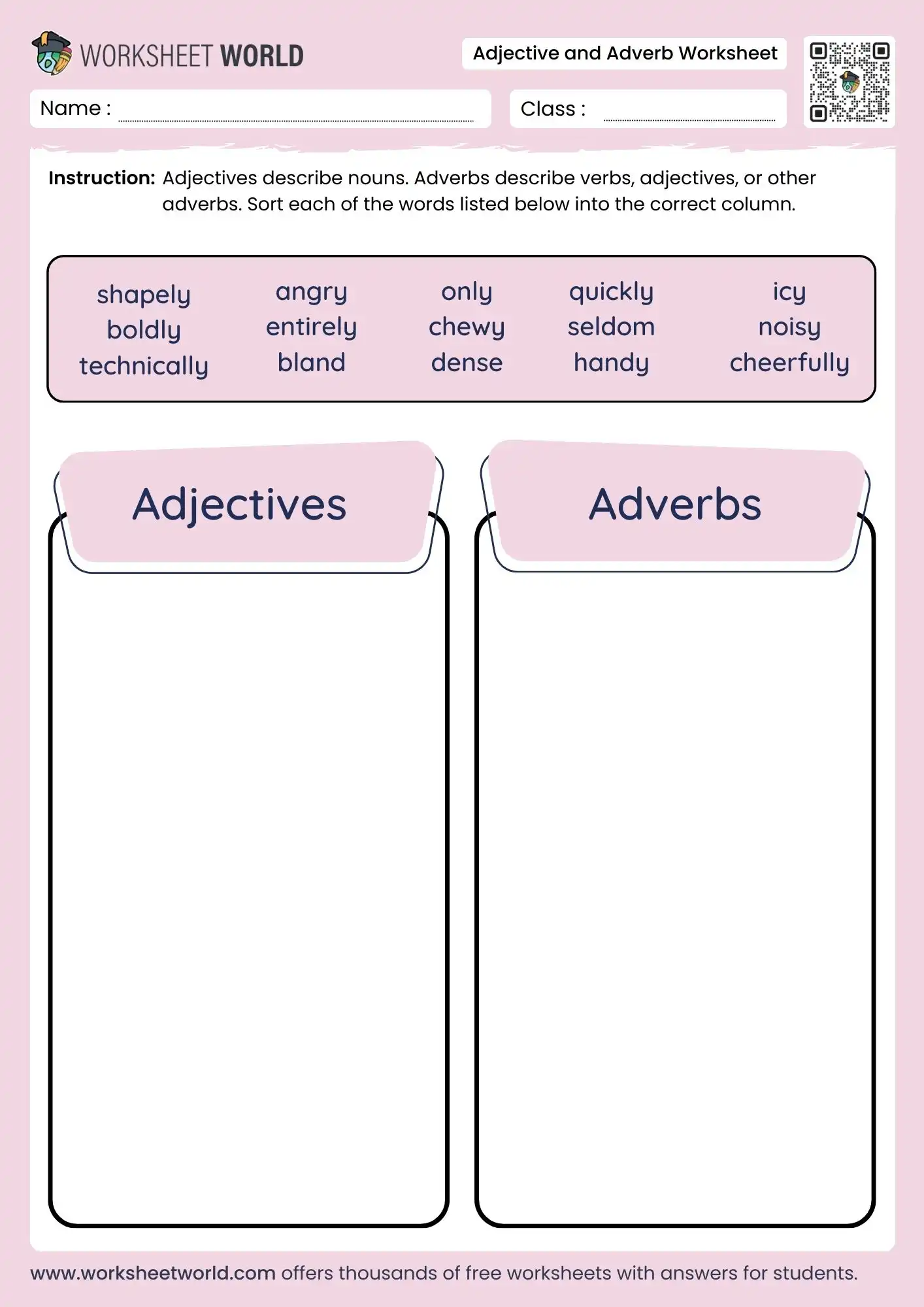
This adjective and adverb worksheet helps young learners understand how describing words work in sentences. With this extra grammar practice students can confidently recognise which words describe nouns and which words tell more about actions. This improves early writing skills and clear communication.
Adjective and Adverb Worksheet With Answers and Free PDF For Class 2, Class 3, Class 4 and Class 5
Children often mix up describing words and action modifiers. These activities guide them in sorting words into the correct category with simple examples. The worksheet supports careful thinking and strengthens foundational grammar understanding.
By classifying each word students learn how to visually identify patterns and apply them in reading and writing tasks. This helps them build confidence and improves their ability to describe things and actions correctly.
Answers
Below are the completed answers for the worksheet.
- Adjectives – shapely, angry, chewy, bland, dense, handy, icy, noisy
- Adverbs – boldly, technically, entirely, only, quickly, seldom, cheerfully
Learning Outcomes
Students learn how to identify describing words for nouns and words that tell more about actions. They practise sorting examples which improves understanding of sentence structure. This builds stronger writing skills and prepares them for advanced grammar topics.
FAQs
Here are some helpful questions related to this topic.
What is an adjective and adverb worksheet used for?
It helps children practise identifying words that describe nouns and words that describe actions or other modifiers.
How can students recognise describing words easily?
They look at whether the word tells about a person or thing or if it explains how an action happens.
Why is this sorting activity helpful?
It trains students to observe patterns which strengthens reading comprehension and writing accuracy.
Quick Summary
This adjective and adverb worksheet gives students clear practice in identifying describing words and action modifiers. It uses simple sorting tasks to build confidence and strengthen grammar skills. With repeated practice children learn how to recognise and use these words correctly in everyday writing.
Was this worksheet helpful?

Download Our Official App
Get exclusive access to premium worksheet PDFs for free! Download the A To Z Worksheet App to explore 2,000+ interactive resources in 10+ languages. Perfect for offline learning and quick printing.

Explore Our Premium Worksheet Store!
Discover our premium collection of worksheets for kids of all ages! Available in English, Hindi, Gujarati, and Marathi bundles, these resources are perfect for home learning and classroom activities. Enhance your child’s learning experience with our carefully designed worksheets.
Explore Now*Terms & conditions apply. Worksheets are intended for educational purposes only.