
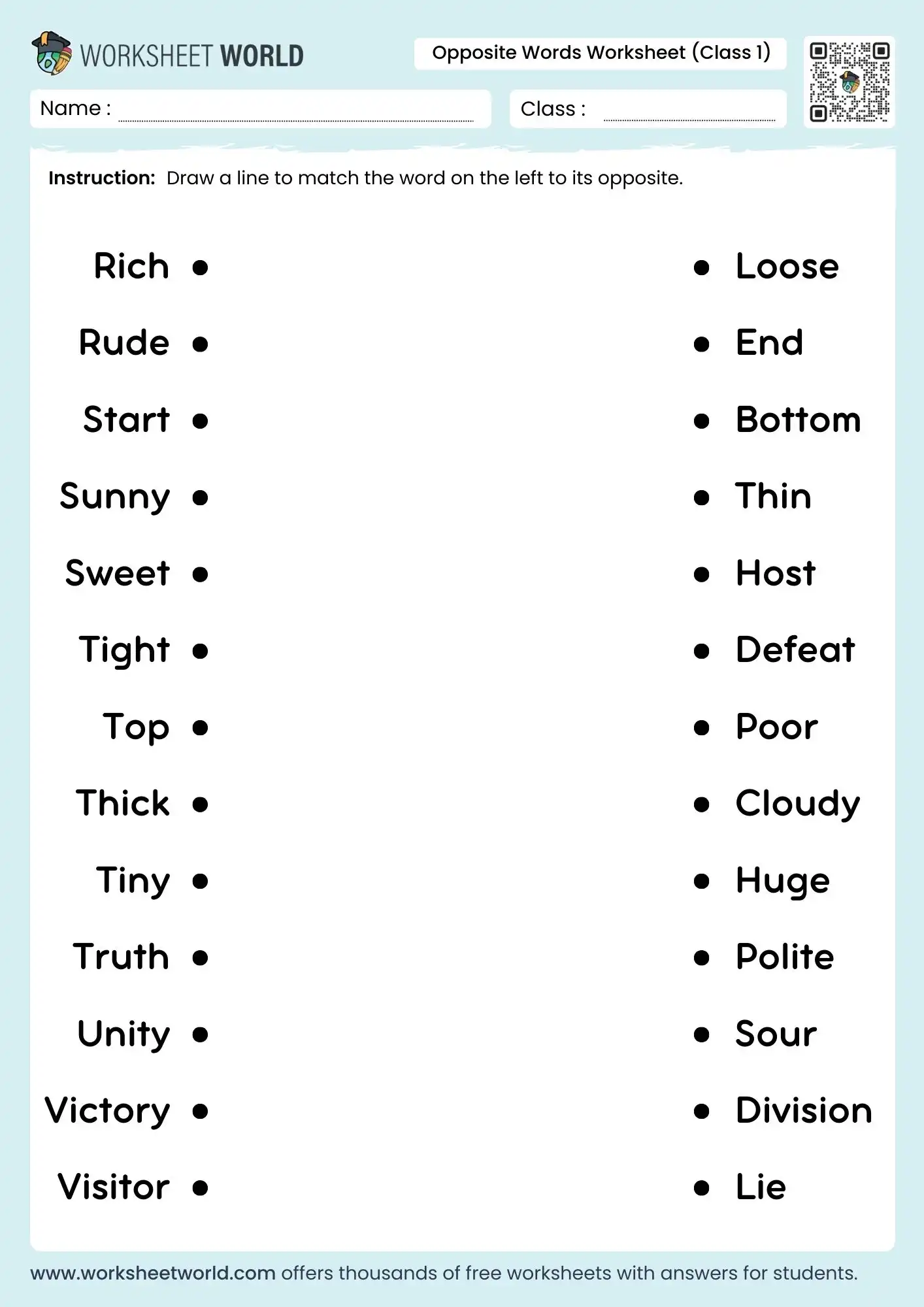
Opposite Words Worksheet For Class 1
This opposite words worksheet for class 1 helps young learners understand simple opposite pairs using clear and familiar words. With an easy matching format and useful extra vocabulary support, children can build confidence as they practise identifying opposite meanings in a fun and engaging way.
Opposite Words Worksheet For Class 1 With Answers and Free PDF
Understanding opposites at an early age helps children improve their descriptive ability and express ideas more clearly. Activities like matching pairs encourage observation, reasoning, and comparison skills that support early language development.
This worksheet includes simple everyday words that are suitable for class 1 learners. The layout makes it easy for children to connect each word with its correct opposite while developing stronger vocabulary for both reading and writing tasks.
Answers
Here are the completed answers for the worksheet shown above.
- Rich → Poor
- Rude → Polite
- Start → End
- Sunny → Cloudy
- Sweet → Sour
- Tight → Loose
- Top → Bottom
- Thick → Thin
- Tiny → Huge
- Truth → Lie
- Unity → Division
- Victory → Defeat
- Visitor → Host
Learning Outcomes
After practising with this worksheet, children will be able to identify opposite meanings with ease. They will also enhance their vocabulary, strengthen critical thinking through comparisons, and develop better understanding of descriptive language used in everyday communication.
FAQs
Below are some helpful questions often asked about this topic.
What is the best way to teach opposite words to class 1 students?
Use simple examples, picture cards, and worksheets to help them understand differences clearly.
How many opposite pairs should a class 1 child learn?
Begin with 10–15 basic pairs and increase gradually as the child becomes confident.
Why are opposite words important in early language learning?
They help children understand contrast, describe things better, and improve overall vocabulary.
Quick Summary
This opposite words worksheet for class 1 offers an easy and engaging way for young learners to practise matching opposite meanings. The activity supports vocabulary growth, strengthens descriptive language skills, and encourages better understanding of word relationships. With clear answers and a free PDF, it becomes a helpful tool for both parents and teachers.
Was this worksheet helpful?
Download Our Official App
Get exclusive access to premium worksheet PDFs for free! Download the A To Z Worksheet App to explore 2,000+ interactive resources in 10+ languages. Perfect for offline learning and quick printing.

Explore Our Premium Worksheet Store!
Discover our premium collection of worksheets for kids of all ages! Available in English, Hindi, Gujarati, and Marathi bundles, these resources are perfect for home learning and classroom activities. Enhance your child’s learning experience with our carefully designed worksheets.
Explore Now*Terms & conditions apply. Worksheets are intended for educational purposes only.