
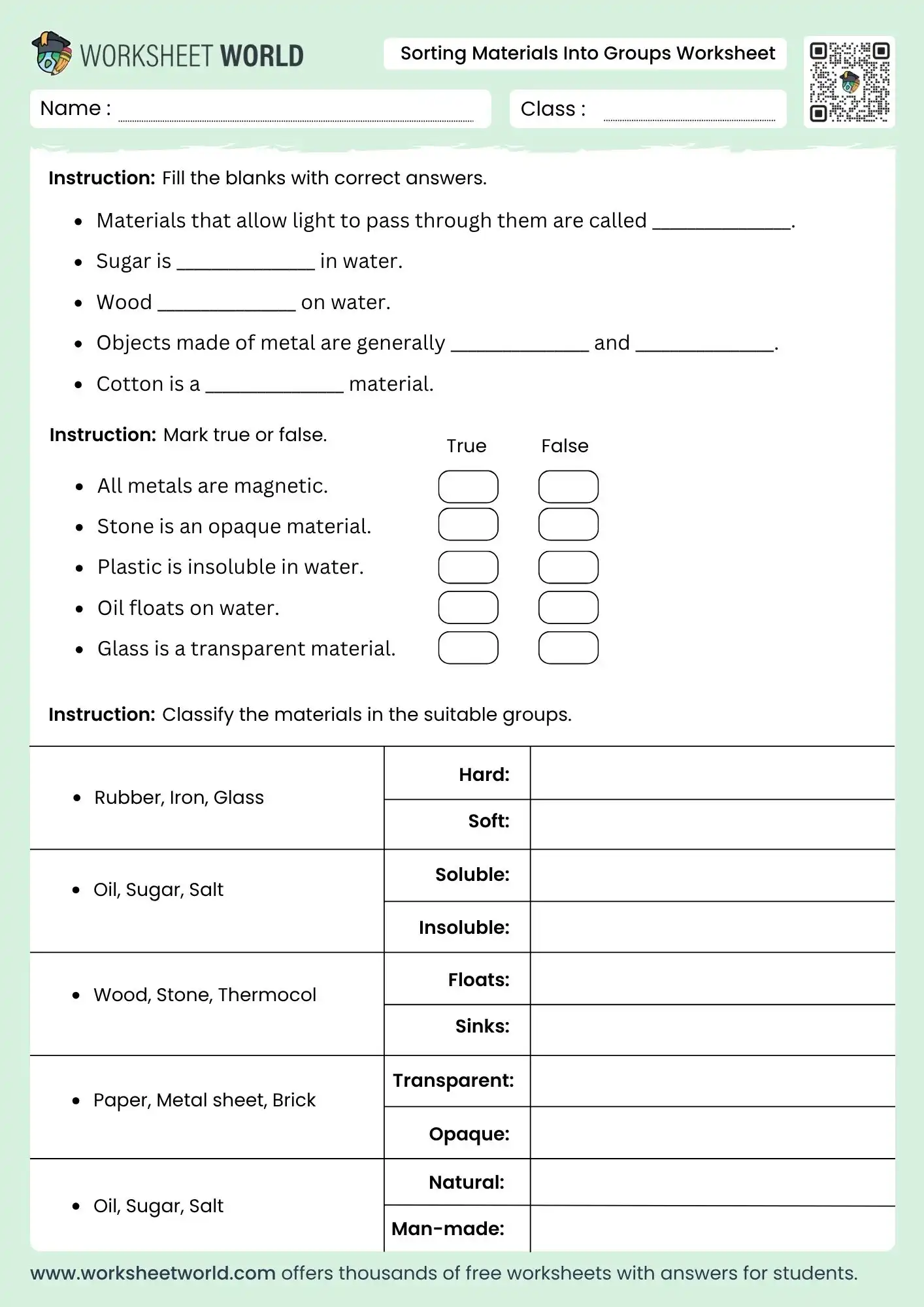
Sorting Materials Into Groups Class 6 Worksheet With Answers
This Sorting Materials Into Groups Class 6 Worksheet With Answers helps students understand how everyday materials behave and how they can be organised using different properties that continue in the extra tasks given below. These exercises strengthen observation skills and make basic science concepts easier through simple, practical examples.
Sorting Materials Into Groups Class 6 Worksheet With Answers and Free PDF
Class 6 science introduces students to material properties and the need for scientific classification. Understanding how objects behave with light, water, and pressure helps children compare materials effectively.
These worksheets present real-world examples that reinforce concepts like transparency, hardness, solubility, and floating or sinking. With guided tasks, students learn to group materials logically and build a strong foundation for advanced science topics.
Answers
Below are the solved answers for all questions shown in the worksheet.
Fill in the blanks
- Materials that allow light to pass through them are called transparent.
- Sugar is soluble in water.
- Wood floats on water.
- Objects made of metal are generally hard and shiny.
- Cotton is a soft material.
True or False
- All metals are magnetic. – False
- Stone is an opaque material. – True
- Plastic is insoluble in water. – True
- Oil floats on water. – True
- Glass is a transparent material. – True
Classify the materials
- Hard: Iron, Glass
- Soft: Rubber
- Soluble: Sugar, Salt
- Insoluble: Oil
- Floats: Wood, Thermocol
- Sinks: Stone
- Transparent: Glass
- Opaque: Paper, Metal sheet, Brick
- Natural: Oil, Sugar
- Man-made: Salt
Learning Outcomes
Students learn how to observe material properties such as transparency, solubility, hardness, and buoyancy. These tasks sharpen scientific thinking, improve classification skills, and help children connect classroom science with everyday objects.
FAQs
These common questions help clarify important ideas related to material classification.
What is included in a sorting materials into groups class 6 worksheet with answers?
It contains fill-ups, true or false questions, and classification tables based on material properties.
Why do we classify materials in science?
Classification helps organise objects by their properties and understand how they behave in different conditions.
What is the difference between transparent and opaque objects?
Transparent materials allow light to pass through, while opaque objects block light completely.
Are all metals magnetic?
No, only a few metals like iron, cobalt, and nickel are magnetic.
Quick Summary
This Sorting Materials Into Groups Class 6 Worksheet With Answers helps children compare and classify materials using simple scientific properties. The worksheet covers transparency, solubility, hardness, and floating or sinking in a student-friendly way. It serves as a complete practice tool for revision, homework, and concept clarity.
Was this worksheet helpful?
Download Our Official App
Get exclusive access to premium worksheet PDFs for free! Download the A To Z Worksheet App to explore 2,000+ interactive resources in 10+ languages. Perfect for offline learning and quick printing.

Explore Our Premium Worksheet Store!
Discover our premium collection of worksheets for kids of all ages! Available in English, Hindi, Gujarati, and Marathi bundles, these resources are perfect for home learning and classroom activities. Enhance your child’s learning experience with our carefully designed worksheets.
Explore Now*Terms & conditions apply. Worksheets are intended for educational purposes only.